Housing accommodation
ESA Letter for Housing in California
An emotional support animal letter is a housing document. It lets your animal live with you where pets are restricted, removes pet rent and deposits, and stops blanket breed bans being applied to it. Here is exactly how to use one, and what your landlord may and may not ask.
Free 15-minute intake call
The short version
What an ESA Letter Does for Housing
One document, three practical effects. Everything else people claim about ESA letters happens outside housing, where they carry no weight at all.
Your Animal Can Live With You
A blanket no-pets policy is not a lawful reason to refuse an approved assistance animal. That is the whole point of the accommodation.
No Pet Rent and No Pet Deposit
An approved assistance animal is not a pet, so pet fees, surcharges and deposits do not apply. You stay responsible for actual damage.
No Blanket Breed or Weight Bans
Restrictions have to be assessed against your actual animal and its actual behavior, not applied by category across the building.
Your rights
Where Your Housing Rights Come From
California protection sits in state law, which is why the federal change in May 2026 did not remove it.
The Fair Employment and Housing Act is the operative law for California tenants. It requires housing providers to consider reasonable accommodation requests supported by appropriate documentation, and it prohibits refusing on the basis of breed, size or weight alone. The California Civil Rights Department enforces it independently of any federal agency.
That independence turned out to matter. When HUD rescinded its assistance-animal guidance on 22 May 2026 and narrowed federal Fair Housing Act enforcement to task-trained animals, a great deal of writing online concluded that ESA housing rights had ended. In California they had not. The Civil Rights Department confirmed as much in a legal alert on 20 July 2026.
The Unruh Civil Rights Act adds a second state route in some circumstances. Between them, FEHA and Unruh mean a California tenant with compliant documentation is in a stronger position than a tenant in most other states right now. Read the full legal breakdown.
What Your Letter Has to Contain
- The clinician's license type, number, jurisdiction and issue date.
- Confirmation the clinician is licensed where you are located.
- Evidence of a client-provider relationship of at least 30 days.
- A completed clinical evaluation of your need for the animal.
- The notice required by Penal Code §365.7.
- Your accommodation need, without disclosing your diagnosis.
The process
How to Submit an ESA Request to Your Landlord
Four steps. Keep every one of them in writing, because a dated paper trail is what protects you if the request is mishandled.
Get Compliant Documentation First
Do not open the conversation until you have the letter. An informal verbal request puts your housing provider on notice without giving them anything to approve.
Send a Short Written Request
State that you have a disability-related need for an assistance animal and are requesting a reasonable accommodation under FEHA. Attach the letter. Do not attach medical records.
Answer Only What They May Ask
They can verify your clinician's license and ask about the animal's behavior. They cannot require your diagnosis, a specific form, a registry entry or a vest. Your clinician can respond in writing if they overreach.
Get the Approval in Writing
Once approved, ask for confirmation in writing and keep it with your lease. It protects you when the building changes hands or the manager changes.
If it goes wrong
What to Do If Your Landlord Refuses
Most refusals we are asked to review rest on something the housing provider was never entitled to require.
Refusals That Do Not Hold
- “Our policy is no pets.” Not a lawful basis for refusing an assistance animal.
- “That breed is banned in this building.” Blanket bans cannot be applied without assessing your animal.
- “Send us your medical records.” They are not entitled to your diagnosis or your chart.
- “Use our form, register the animal, buy a vest.” None of these can be required.
- “We are still considering it.” Indefinite delay can itself be treated as a refusal.
Refusals That Might
- Documented evidence that your specific animal threatens health or safety.
- Documented evidence it would cause substantial physical damage.
- Your documentation genuinely fails §122318 — which is why the letter has to be written properly.
- The animal is breaking the same rules that apply to every resident.
An ESA Letter Covers Housing Only
Emotional support animals have no public-access rights. An ESA letter does not let you bring an animal into restaurants, shops or hotels, and airlines have not accepted ESA documentation for cabin travel since the Department of Transportation rule of 11 January 2021. Presenting an animal as a service dog when it is not is a misdemeanor under Penal Code §365.7. If you need public access, you are looking for a psychiatric service dog, and that comes from task training rather than paperwork.
Our team
Our Licensed Mental Health Professionals
Every evaluation is done by a professional licensed by a California board. You get their license type and number before you pay, so you can check it yourself on the board’s public lookup.
Client experiences
What Our Clients Say
Six clients on getting an accommodation approved.
My building had a hard no-pets rule and a waiting list. I sent the letter with the accommodation request and had written approval in six days, no pet rent.
The property manager asked for my diagnosis. My clinician wrote back explaining what they were and were not entitled to ask. They dropped it and approved the request.
My HOA said the breed was banned building-wide. Turns out a blanket ban does not apply to an assistance animal. I have that in writing now and my dog is still here.
Student housing was the tricky one. The letter went to the disability office rather than the landlord and it was handled in under two weeks.
I was already being charged pet rent when I applied. Once the accommodation was approved they stopped charging it going forward.
What sold me was that the license number was on the letter. My landlord looked it up before approving. A letter without that would have gone nowhere.
Questions
ESA Housing Questions
Six answers on landlords, fees, HOAs and what happens when a request is refused.
Does a California landlord have to accept my ESA letter?
A housing provider has to consider a properly documented accommodation request and cannot refuse it simply because a no-pets policy exists. They can still refuse a specific animal that poses a direct threat to health or safety, or that would cause substantial physical damage, but they need evidence for that and it has to be about your animal rather than its breed. What they cannot do is reject compliant documentation on a technicality, which is exactly why the §122318 elements matter.
Can my landlord charge pet rent or a pet deposit?
No. Once an assistance animal is approved as a reasonable accommodation it is not a pet, so pet rent, pet deposits and pet surcharges do not apply. You remain fully responsible for any damage the animal causes and for its behavior, and a housing provider can bill you for actual damage in the normal way.
What do I actually send my landlord?
A short written accommodation request plus the letter itself. The request says you have a disability-related need for an assistance animal and are asking for an accommodation under FEHA. The letter supplies the clinical support. You do not send your diagnosis, your chart or your medical records, and a housing provider is not entitled to ask for them.
How long does a landlord have to respond?
California does not set a fixed number of days, but a housing provider is expected to respond within a reasonable time and an unexplained delay can itself be treated as a refusal. In practice most requests are answered within one to two weeks. If yours goes quiet, a follow-up in writing that creates a dated record is the right next step.
Does this work for HOAs, condos and student housing?
Yes. FEHA applies to homeowners associations and condominium boards as well as to conventional landlords, and university housing is covered too. Student housing usually routes the request through a campus disability services office rather than a housing manager, which often moves faster.
What if my landlord says no?
Ask for the reason in writing. Most refusals we see are based on something the housing provider is not permitted to require — a specific form, a registry entry, a vest, or your diagnosis. Your clinician can respond in writing citing the relevant code section, which resolves the majority of them. If it does not, the California Civil Rights Department accepts housing discrimination complaints. See what landlords can and cannot do.
The document
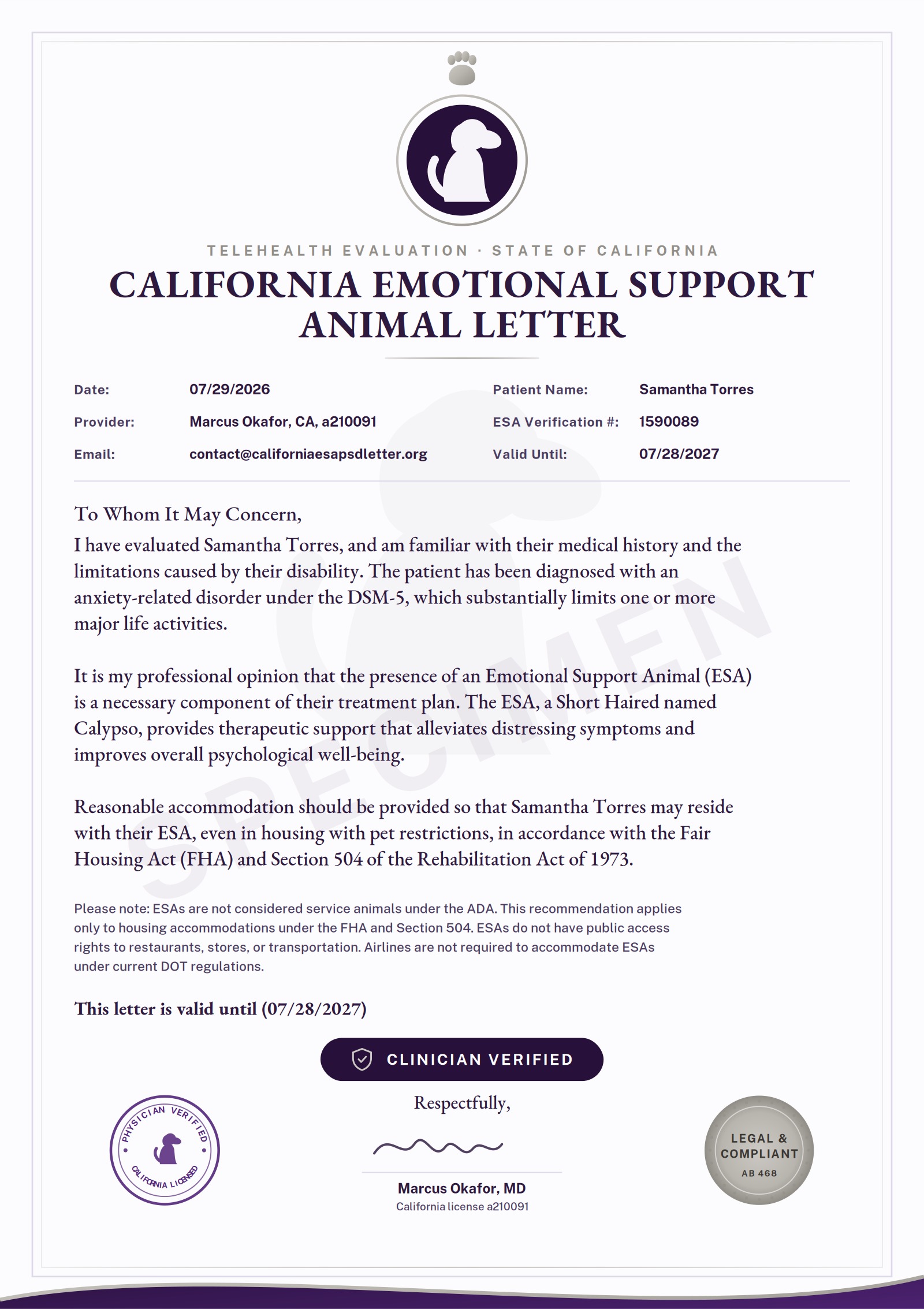
What Your ESA Letter Looks Like
Every letter carries the five elements Health & Safety Code §122318 requires, on the page where a housing provider can see them.
- License in full. Type, number, issuing jurisdiction and effective date.
- Licensed where you are. Confirmation the clinician may practice in your jurisdiction.
- Thirty-day relationship. Evidence the statutory care period was met.
- Completed clinical evaluation. An assessment of your need for the animal.
- The §365.7 notice. The disclosure California requires you to receive.
- Need without diagnosis. Your accommodation need, with your diagnosis kept private.
Specimen only. Patient name, provider, license number and verification number shown here are illustrative and are populated from your own clinician’s record on a real letter.
Keep reading
Explore the Rest of the Site
Everything here is written for California specifically — the statutes, the prices and the process are all state law rather than general advice.
Home
How the process works, what we help with, and fifteen of the questions we are asked most.
Read this pageAbout us
Our standards, how the clinician network is built county by county, and the shortcuts we refuse.
Read this pageCalifornia ESA laws
AB 468 requirement by requirement, FEHA housing rights, the 2026 HUD change, and where an ESA has no rights at all.
Read this pageESA letter renewal
Whether California ESA letters expire, when renewal is worth doing, and how it works for existing clients.
Read this pageCost
Four prices in full, what each one includes, and what happens to your money if you are not approved.
Read this pageBook an appointment
Pick a video slot with a clinician licensed in your own California county.
Read this pageNext step
Start Your California ESA Evaluation
The intake call is free. You will leave it knowing whether a letter is the right tool, what it costs, and the date it can be issued.
Free 15-minute intake · no charge if you are not approved