Serving all 58 California counties
Get Your California ESA Letter Online
Connect with a mental health professional licensed in California for an online evaluation from home. Once your clinician approves, your signed letter is delivered within 15 minutes. Nothing is charged to book, and you only pay after approval.
Free 15-minute intake call
Timeline
How Fast Can You Get a California ESA Letter?
Two different clocks get confused constantly, so here they are separately. Delivery is instant. Approval is not, and by law it cannot be.
Booking: about two minutes
Pick a slot on the scheduler. Nothing is charged at this stage. Your first appointment is what starts the statutory clock.
Approval: thirty days minimum
California Health & Safety Code §122318(a)(3) requires a 30-day client-provider relationship before any ESA letter can be issued. There is no hardship exception and no way to pay to skip it.
Delivery: within 15 minutes
The moment your clinician approves, your signed PDF is generated and emailed. That is the 15 minutes — the paperwork, not the evaluation.
Our team
Our Licensed Mental Health Professionals
Every evaluation is done by a professional licensed by a California board. You get their license type and number before you pay, so you can check it yourself on the board’s public lookup.
Eligibility
Who Qualifies for an ESA Letter in California
There is no list of approved diagnoses in the statute. What matters is whether a condition limits something you need to do day to day, and whether the animal helps with it.
Ongoing Anxiety
A steady background of worry or overthinking that makes ordinary tasks harder than they should be. This is the most common reason people are evaluated.
Panic Attacks
Sudden episodes of intense fear, often with chest tightness, dizziness or shortness of breath, that make being alone difficult.
Post-Traumatic Stress
Strong reactions, intrusive memories or physical tension triggered by past events, including sleep disruption and hypervigilance.
Mood and Neurodivergent Conditions
Depression, bipolar disorder, ADHD, autism spectrum conditions, social anxiety and specific phobias all come up regularly.
A Diagnosis Alone Does Not Qualify You
None of the conditions above qualify automatically. The test under California law is whether you have a condition that substantially limits a major life activity, and whether this particular animal addresses that limitation. Only a California-licensed clinician can make that call, and only after a real evaluation. Anyone promising approval before that has happened is selling you something they cannot deliver.
Requirements
Basic Requirements for a California ESA Letter
Six conditions have to be met before a letter can lawfully be issued. Five come from Health & Safety Code §122318; the first is ours.
What You Need to Meet
- You are 18 or older. Minors can be evaluated with a parent or guardian involved.
- You live in California, or you are moving here with the animal.
- You are physically in California during the evaluation, as §122318(a)(2) requires.
- You have a mental or emotional health condition that limits a major life activity.
- You complete the 30-day client-provider relationship the statute requires.
- A California-licensed clinician completes a clinical evaluation of your need.
The 30-day requirement is the one that surprises people, so it is worth saying plainly: there is no lawful way to get a California ESA letter faster. No hardship exception exists. No lease deadline overrides it. Any California service advertising a letter in 24 hours is describing something that fails the statute.
The clock starts at your first appointment, not when you fill in a form. That is why we tell people to book as soon as they think they might need documentation, rather than waiting until a landlord asks for it.
If your deadline is sooner than thirty days, tell us on the intake call. We cannot shorten the wait, but a letter from your clinician confirming that an evaluation is underway often buys the time you need. Read the statute in full.
The process
How the Evaluation Process Works
Three steps. Only one of them takes any real time, and that one is set by state law rather than by us.
Book Your Appointment
Pick a time with a clinician licensed in your county. Nothing is charged to book, and the first fifteen minutes are free. This appointment starts the statutory 30-day relationship.
Clinical Evaluation and Ongoing Care
You meet privately by secure video. The clinician takes a history, asks what changes when the animal is present, and stays in contact with you across the thirty days.
Clinical Determination
If the clinician concludes that documentation is clinically supported, your letter is issued as a signed PDF carrying every element the statute requires.
Why Our Process Is Different
- No instant letters and no automated approvals.
- California-licensed clinicians only, matched by county.
- Documentation written to §122318, element by element.
- Secure telehealth, and no diagnosis disclosed in the letter itself.
What We Will Not Do
- Backdate a letter or issue one before day thirty.
- Sell certificates, ID cards, vests or registry listings.
- Guarantee approval before an evaluation has happened.
- Claim an ESA letter grants access to shops, restaurants or aircraft cabins.
Pricing
ESA and PSD Letter Pricing in California
Four prices, published in full. Each covers the clinician's time across the whole thirty days, the evaluation, the letter, and follow-up correspondence with your housing provider.
- Free 15-minute intake call
- Matched to a California-licensed clinician
- 30-day care relationship, as §122318 requires
- Full clinical evaluation
- Covers up to 2 animals
- Landlord correspondence for 12 months
- Everything in the ESA Letter
- Covers 3 or more animals
- Each animal assessed on its own terms
- One letter listing every animal
- Extra care on wording, since larger requests draw more scrutiny
- Free 15-minute intake call
- Psychiatric disability documentation
- Guidance on the DOT Service Animal Air Transportation Form
- Task-training guidance and trainer referral
- Covers up to 2 dogs
- Landlord correspondence for 12 months
- Everything in the PSD Letter
- Covers up to 3 dogs
- Each dog assessed on its own terms
- Priority clinician matching
- Separate documents for housing and for airlines
2026 legal update
Federal Guidance Changed. California Law Did Not.
HUD withdrew its assistance-animal guidance in May 2026. If you have read that your rights are gone, that is not the case in California.
On 22 May 2026 HUD's Office of Fair Housing rescinded the 2013 and 2020 notices that shaped assistance-animal practice for a decade. It now enforces the Fair Housing Act only for animals individually trained to perform tasks. Emotional support animals lost their federal enforcement route.
California protection sits in state law and was untouched. On 20 July 2026 the California Civil Rights Department confirmed that FEHA and the Unruh Civil Rights Act still require housing providers to consider assistance-animal accommodation requests. Your rights here come from Sacramento, not Washington.
Your options
Where You Can Get a California ESA Letter
Three legitimate routes and one that wastes your money. Worth knowing before you pay anyone, including us.
Your Own Therapist or Doctor
If you are already in care with a California-licensed provider, ask them first. The 30-day relationship is already satisfied and it usually costs nothing beyond a normal session. Not every provider is comfortable writing housing documentation, but this is the cheapest place to start.
A Local Clinic or County Service
County behavioral health services and community clinics can evaluate you, often on a sliding scale. Waiting lists vary a great deal by county, and not all of them handle housing paperwork.
A Telehealth Service Like This One
Useful if you are not currently in care, if your provider has declined, or if you want someone who writes to §122318 routinely. You still get a real clinician and a real thirty days. The convenience is in the scheduling, not in skipping steps.
Registries, Certificates and Instant Letters
Not a route at all. No government ESA registry exists anywhere in the United States. Any California site promising a letter in 24 hours is describing something that fails the statute.
Benefits
Benefits of an ESA Letter in California
What a compliant letter actually gets you, split into the practical and the personal.
Housing and financial
No Pet Rent or Deposits
When an assistance animal is approved as a reasonable accommodation, it is not a pet. A housing provider may not charge pet rent, a pet deposit or a pet surcharge. You remain responsible for any damage.
Access to No-Pets Housing
A blanket no-pets policy is not a lawful reason to refuse an approved assistance animal, which widens the range of buildings genuinely open to you.
Protection From Breed and Size Bans
Blanket breed, weight and size limits cannot be applied to an assistance animal without assessing your actual animal and its actual behavior.
Mental health
A Steadier Baseline
Having the animal present at home lowers the constant background alertness that people with anxiety and PTSD describe. That is the effect clinicians document most often.
Less Isolation
Daily companionship and routine matter, particularly for people who live alone or whose condition makes leaving the house difficult.
Faster Recovery From Bad Moments
An animal that reliably interrupts a spiral shortens it. Clients describe getting back to baseline in minutes rather than hours.
Your rights
ESA Laws in California: Housing and Tenant Rights
Two bodies of law apply. FEHA gives you the accommodation right; AB 468 sets the rules your letter has to follow to be worth anything.
Fair Employment and Housing Act
- Housing providers must consider a reasonable accommodation request supported by proper documentation.
- A refusal cannot rest on breed, size or weight alone.
- An approved assistance animal is not a pet, so pet rent and pet deposits do not apply.
- Employees may request workplace accommodation, though approval depends on the role and setting.
- Enforced by the California Civil Rights Department, independently of federal action.
California AB 468
- A 30-day client-provider relationship before any letter is issued.
- A completed clinical evaluation of your need for the animal.
- License type, number, jurisdiction and issue date stated in the letter.
- The clinician must be licensed where you are located.
- You must be told in writing that an ESA is not a service animal.
An ESA Letter Does Not Give Public Access
Emotional support animals are protected in housing when approved as a reasonable accommodation. They have no public-access rights. An ESA letter does not entitle you to bring an animal into restaurants, shops, hotels or other places that restrict animals, and it does not secure a seat in an aircraft cabin. Airlines stopped accepting ESA documentation after the Department of Transportation rule of 11 January 2021. Knowingly presenting an animal as a service dog is a misdemeanor under California Penal Code §365.7.
Landlords
What Landlords Can and Cannot Do
California law is more protective than the current federal position, and it did not change when HUD narrowed its enforcement in May 2026.
What a Housing Provider May Do
- Ask for documentation where your disability-related need is not obvious.
- Verify that your clinician holds a current California license.
- Refuse a specific animal that poses a direct threat to health or safety, with evidence.
- Refuse an animal that would cause substantial physical damage, with evidence.
- Hold you responsible for damage and for the animal's behavior.
- Apply the same noise, cleanliness and leash rules that apply to every resident.
What a Housing Provider May Not Do
- Refuse simply because a no-pets policy exists.
- Charge pet rent, a pet deposit or a pet surcharge for an approved animal.
- Apply blanket breed, weight or size limits without assessing your animal.
- Demand your diagnosis, your chart or your full medical records.
- Require a specific form, registry entry, certificate or vest.
- Delay indefinitely, or refuse without giving a specific written reason.
Scams
ESA Scams: What Is Real and What Is Fake
Knowing what California actually requires is the fastest way to spot a service that cannot deliver it.
What You Actually Need
- A letter from a licensed clinician. Written by a mental health professional licensed to practice in California.
- A clinical evaluation. An actual assessment of your need for the animal, not a scored questionnaire.
- A 30-day relationship. Established before the letter is issued, with no exceptions.
- License details on the page. Type, number, jurisdiction and issue date.
- Ongoing care. A clinician who is still there when your landlord asks a question.
Common ESA Scams
- Offers to register or certify your animal. No such registry exists.
- Certificates, ID cards, tags and vests sold as legal proof. They are not.
- Instant or same-day ESA letters. Unlawful in California.
- Letters with no license details and no §365.7 notice.
- Any guarantee of housing approval before an evaluation has happened.
No Official ESA Registry Exists
There is no government-approved ESA registry, database or certification scheme in California or anywhere else in the United States. California law goes further than simply not recognizing them: anyone selling an ESA certificate, ID card, vest or tag must state in writing that the product confers no rights. If a site sells you one without that notice, it is breaking state law while taking your money.
ESA or PSD
ESA vs Psychiatric Service Dog in California
The difference is training. An emotional support animal helps by being present. A psychiatric service dog is trained to perform specific tasks, and that training is what creates public-access rights.
| ESA Letter | PSD Letter | |
|---|---|---|
| Housing and rentals | Protected | Protected |
| Pet rent, deposits, breed limits | Waived | Waived |
| Shops, restaurants, venues | No access right | Access under the ADA |
| Cabin air travel | Treated as a pet since Jan 2021 | Accepted with the DOT form |
| Training required | None | Individual task training |
| Eligible animals | Most household animals | Dogs only |
| Price here | $129 – $199 | $149 – $229 |
Requirements
What a Valid California ESA Letter Must Contain
Six things. A letter missing any of them hands your housing provider an easy reason to ask for another one.
The License, in Full
Type, number, issuing jurisdiction and effective date, written into the letter rather than implied by a signature.
A Clinician Licensed Where You Are
Licensed to practice in the jurisdiction where the documentation is provided. An out-of-state clinician cannot lawfully write a California ESA letter.
Thirty Days of Relationship
Established at least 30 days before the letter is issued. No hardship exception exists.
A Completed Clinical Evaluation
An actual assessment of your need for the animal. This is where questionnaire-based letters fail.
The §365.7 Notice
You must be told that fraudulently presenting an animal as a service dog is a misdemeanor.
Need Without Diagnosis
Not required by statute, but the mark of a well-written letter: it establishes the accommodation need while keeping your diagnosis private.
Why us
Why Choose Us
License Numbers Before You Pay
You get your clinician's license type and number up front and can verify it yourself on the issuing board's public lookup. Most services will not give you this until after the transaction.
An Evaluation That Can Return a No
About one in six people who complete an intake call are told a letter is not the right tool for them. A service that approves everybody is not evaluating anybody.
We Will Not Bend the Thirty Days
No backdating and no early issue, whatever your lease deadline is. A letter that fails §122318 is worth less to you than no letter at all.
Support After the Letter Lands
Your clinician answers legitimate verification questions from your housing provider in writing, at no extra cost, for twelve months.
You Pay Only After Approval
Nothing is charged to book and nothing is charged for a letter that is not issued. You pay once your clinician has approved your documentation, not before.
Written So There Is Nothing to Reject
Every letter carries all five elements §122318 requires, with the license verifiable on a state board lookup. That removes the compliance grounds a housing provider would otherwise use to refuse it.
Built County by County
Because the statute requires the clinician to be licensed where you are, the network is organized by county rather than nationally. All 58 are covered.
No Registries, Ever
We do not sell certificates, ID cards, vests, tags or registry listings, because none of them carry any legal weight.
Coverage
Serving All of California
Every appointment happens over secure video, so the whole state is covered — all 58 counties, from San Diego to Eureka.
Los Angeles
Strict pet policies are the norm across the county. Documentation that survives scrutiny matters more here than almost anywhere.
San Francisco Bay Area
Rentals move fast and competition is fierce. A compliant letter keeps you in the running for buildings that restrict animals.
San Diego
Breed and size restrictions are widespread. An assistance animal has to be assessed individually rather than banned by category.
Sacramento
Landlords here tend to know AB 468 well, which cuts both ways: a compliant letter is respected, a defective one is spotted immediately.
San Jose and the Peninsula
Dense housing means more restrictions per building. Clear documentation is the practical route through.
Oakland and the East Bay
Tenant protections are strong locally, and a valid accommodation request adds another layer on top.
Fresno and the Central Valley
Fewer buildings and more restrictions. Telehealth reaches counties where in-person clinicians are thin on the ground.
Everywhere Else
Bakersfield, Long Beach, Anaheim, Riverside, Santa Barbara, Stockton, Chico, Redding and the rest. If you are in California, you are covered.
Eligibility check
Check If You Qualify
Three questions, about thirty seconds. This is a guide only — whether you qualify is decided by a licensed clinician after an evaluation, never by a website.
Are you a California resident, aged 18 or over?
Do you experience anxiety, depression, PTSD or a similar condition?
Does your animal help with those symptoms in a way you could describe?
You Look Like a Reasonable Candidate
From your answers, a licensed California clinician is well placed to evaluate you. The intake call is free and takes fifteen minutes, and you are charged nothing if a letter turns out not to be right for you.
Hard to Say From Three Questions
Your answers do not rule anything out, but they do not point clearly either way. That is exactly what the free intake call is for: fifteen minutes and an honest answer about whether a letter is the right tool for your situation.
We Are Not Able to Help With This One
Section 122318(a)(2) requires the clinician to be licensed where you are located, so we can only evaluate people who are in California. If you are under 18, a parent or guardian needs to be involved. Write to us and we will explain how that works.
Guidance only. Nothing here is a clinical opinion, a diagnosis, or a promise that a letter will be issued.
Trust
Why This Holds Up When Someone Checks
Anyone can claim to be legitimate. These are the parts you can check yourself.
AB 468 compliant
Every letter is written to Health & Safety Code §122318 — all five practitioner requirements, on the page.
California-licensed only
LMFT, LCSW, LPCC, psychologist, psychiatrist or physician, licensed by a California board.
Independently verifiable
You get the license type and number before you pay, checkable on the issuing board's public lookup.
Private by design
Telehealth sessions are confidential. Your letter states your need for the animal without naming your diagnosis.
Our guarantees
Not approved, not charged
If the clinician concludes a letter is not clinically supported, you pay for sessions attended and nothing for a letter.
No hidden fees, ever
The published price is the price. No rush fee, no delivery fee, no subscription that renews unless you ask.
12 months of landlord support
Your clinician answers legitimate verification questions from your housing provider in writing, at no extra cost.
Free 15-minute intake
Client experiences
What Our Clients Say
Six clients on what changed once the documentation reached their housing provider.
I'd already been turned down once with a letter I bought online for $45. The difference here was that someone actually treated me. My property manager approved it in four days without a single follow-up question.
They told me on the first call that I probably didn't need a letter because my lease already allowed cats. Nobody has ever talked me out of buying something before. When I moved to a no-pets building a year later, I knew exactly who to call.
The 30-day wait annoyed me until I understood why it exists. Having a therapist who knew my history made the letter feel like part of my care instead of a receipt.
My HOA pushed back hard and asked for things they weren't entitled to ask for. My clinician wrote back the same week and cited the code section. That ended it.
I needed PSD documentation for flights, not an ESA letter, and they were the first people who explained the difference instead of upselling me. The DOT form walkthrough saved my trip.
Renewal took twenty minutes because they still had my file. New date, signed, done two weeks before my lease deadline.
Questions
Frequently Asked Questions
Fifteen answers about California ESA letters, the thirty-day rule, housing rights and what this costs.
Do I actually need an ESA letter in California?
If your building has a no-pets policy, a weight or breed restriction, or charges pet rent, then yes — a letter from a licensed clinician is how you request a reasonable accommodation. If your housing already allows your animal without restriction, you may not need anything. We will tell you that on the free intake call rather than sell you a document you do not need.
What makes an ESA letter valid under California law?
Health & Safety Code §122318, added by AB 468, sets five conditions. The clinician must hold a valid, active license and state the license type, number, jurisdiction and effective date in the letter; be licensed in the jurisdiction where you are located; have an established client-provider relationship with you for at least 30 days before issuing the letter; complete a clinical evaluation of your need for the animal; and notify you that misrepresenting an animal as a service dog is a misdemeanor. A letter missing any of these is easy for a landlord to challenge. Read the full breakdown.
Why can't I get an ESA letter the same day?
Because California law forbids it. The 30-day client-provider relationship in §122318(a)(3) is a hard statutory minimum, not a policy we invented. Any California service advertising a letter in 24 or 48 hours is either issuing non-compliant documentation or using a clinician who is not licensed here. Both are risks you inherit when your landlord looks closely.
Can my landlord reject my ESA letter?
A housing provider can question documentation that does not meet the statutory requirements, and can deny a specific animal that poses a direct threat to the health or safety of others or would cause substantial physical damage — neither of which is presumed. What they cannot do is refuse the request simply because a no-pets policy exists. We build the letter so the easy grounds for rejection are closed off before it reaches them.
Is an online ESA registration, ID card, or certificate the same thing?
No. There is no official ESA registry in the United States, and no state or federal agency recognizes one. Under §122317, sellers of ESA certificates, ID cards, vests, tags, leashes and harnesses must give buyers written notice that the product confers no legal rights at all. What creates a housing right is a clinician's assessment of your disability-related need — the paperwork simply documents it.
What is the difference between an ESA and a psychiatric service dog?
An emotional support animal helps through its presence and needs no training. A psychiatric service dog is individually trained to perform specific tasks tied to a psychiatric disability — interrupting a panic response, retrieving medication, guiding you out of a crowd. That training is what gives a PSD public-access rights under the ADA. An ESA has housing protections but no public-access rights. Compare all three categories.
Did the May 2026 federal change take away my rights in California?
No. On 22 May 2026, HUD's Office of Fair Housing and Equal Opportunity rescinded its 2013 and 2020 assistance-animal notices and said it will pursue Fair Housing Act accommodation charges only for individually trained animals. That is a change in federal enforcement priorities — the Fair Housing Act itself was not amended, and private lawsuits remain available. Separately, California's Civil Rights Department confirmed in a July 2026 legal alert that FEHA and the Unruh Civil Rights Act are unaffected and still require housing providers to accommodate assistance animals, including untrained ESAs. In California, state law is your floor.
Can my landlord charge pet rent or a pet deposit for my ESA?
Under California law an approved assistance animal is not a pet, so pet rent, pet deposits and breed or weight surcharges should not apply to it. You remain responsible for any actual damage the animal causes, and for its behavior, exactly as you would be for your own. If a housing provider insists on pet fees after a valid accommodation request, that is a matter you can raise with the Civil Rights Department.
Can I bring my emotional support animal on a plane?
Not as an ESA. Since the Department of Transportation's rule took effect on 11 January 2021, airlines are no longer required to accommodate emotional support animals and may treat them as ordinary pets, with the usual carrier fees and cabin rules. Only trained service dogs qualify, and airlines can require the DOT Service Animal Air Transportation Form. If air travel is the reason you are here, a psychiatric service dog is the path worth discussing.
Does an ESA letter let me take my animal into stores and restaurants?
No, and this is the single most common misunderstanding. The ADA covers dogs individually trained to do work or perform tasks. Emotional support animals are explicitly excluded from public-access rights. Presenting an ESA as a service dog is a misdemeanor under California Penal Code §365.7, punishable by up to six months in county jail, a fine of up to $1,000, or both.
How many animals can one letter cover?
There is no fixed cap. The clinician documents the disability-related need, so if two animals each serve a distinct, clinically supported function, both can be included. What does not work is adding a second animal for convenience. The evaluation has to support each one on its own terms.
Does my emotional support animal have to be a dog?
No. Health & Safety Code §122319.5 defines an emotional support animal broadly, and housing accommodation requests under FEHA are not limited to dogs. Cats, rabbits and other common household animals are regularly accommodated. Note that AB 468's notice and practitioner rules are written specifically around emotional support dogs, and that exotic or unusual animals draw far more scrutiny from housing providers.
How long is an ESA letter good for?
No statute sets an expiry date. In practice most California housing providers treat documentation older than twelve months as stale and ask for something current, so annual renewal is the working standard. Renewal with a clinician who already knows you is faster and cheaper than starting over, which is why we keep your file open.
Can I be denied because of my dog's breed, weight, or size?
Breed and weight restrictions are pet policies, and an approved assistance animal is not being kept as a pet. A housing provider must assess your specific animal's actual conduct and history rather than apply a blanket ban — so "we don't allow pit bulls" is not, by itself, a lawful reason to refuse an accommodation. Insurance-based objections are common and are usually negotiable.
What happens if the clinician decides I don't qualify?
Then you do not get a letter, and you are not charged for one. We are candid about this because it is the difference between a clinical service and a document mill: the evaluation has to be able to reach either answer. If the outcome is no, the clinician will explain the reasoning and, where it helps, point you toward care that fits your situation better.
The document
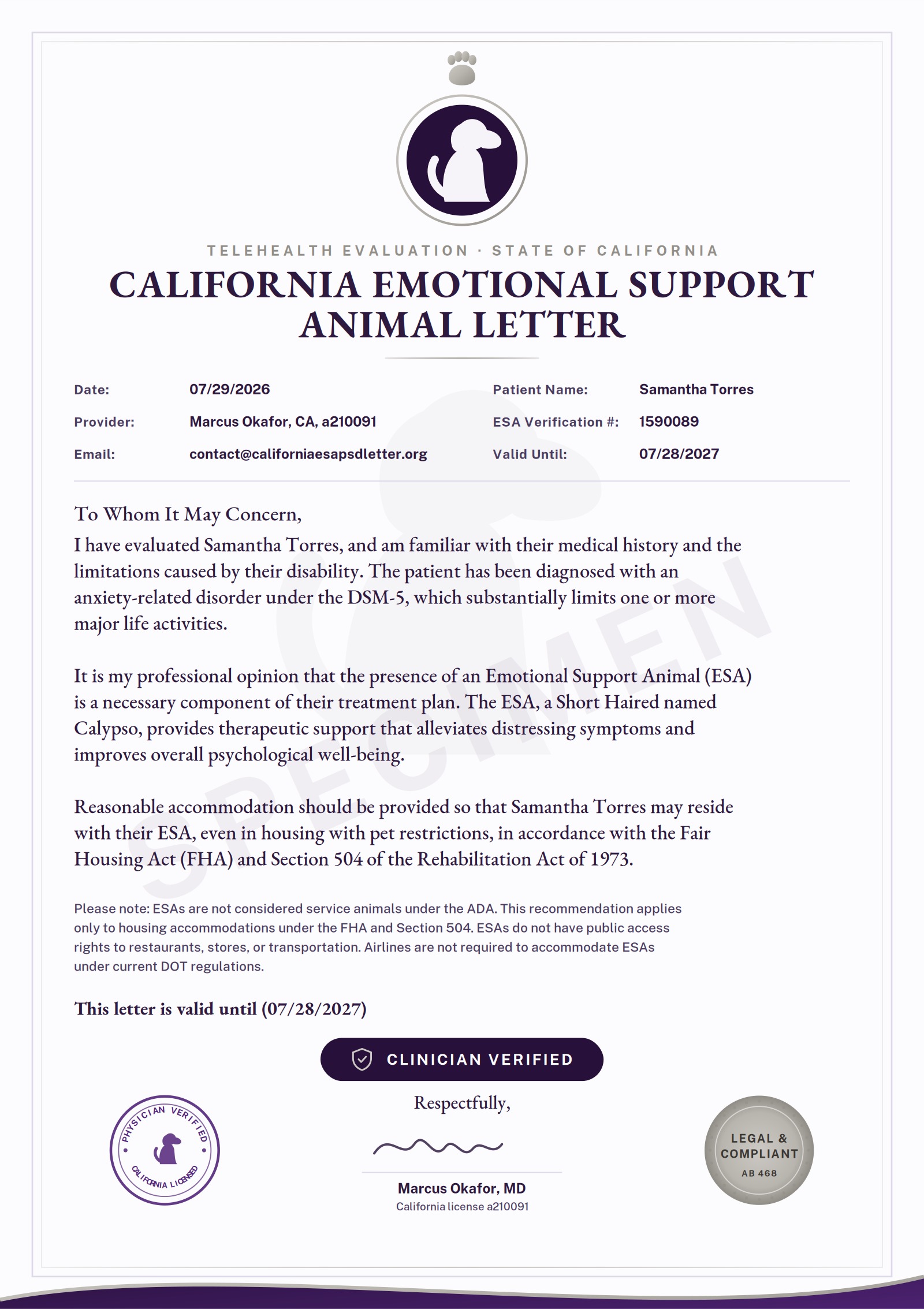
What Your ESA Letter Looks Like
Every letter carries the five elements Health & Safety Code §122318 requires, on the page where a housing provider can see them.
- License in full. Type, number, issuing jurisdiction and effective date.
- Licensed where you are. Confirmation the clinician may practice in your jurisdiction.
- Thirty-day relationship. Evidence the statutory care period was met.
- Completed clinical evaluation. An assessment of your need for the animal.
- The §365.7 notice. The disclosure California requires you to receive.
- Need without diagnosis. Your accommodation need, with your diagnosis kept private.
Specimen only. Patient name, provider, license number and verification number shown here are illustrative and are populated from your own clinician’s record on a real letter.
Keep reading
Explore the Rest of the Site
Everything here is written for California specifically — the statutes, the prices and the process are all state law rather than general advice.
About us
Our standards, how the clinician network is built county by county, and the shortcuts we refuse.
Read this pageCalifornia ESA laws
AB 468 requirement by requirement, FEHA housing rights, the 2026 HUD change, and where an ESA has no rights at all.
Read this pageESA letter for housing
How an ESA letter works with California landlords, HOAs and student housing, and what to do if a request is refused.
Read this pageESA letter renewal
Whether California ESA letters expire, when renewal is worth doing, and how it works for existing clients.
Read this pageCost
Four prices in full, what each one includes, and what happens to your money if you are not approved.
Read this pageBook an appointment
Pick a video slot with a clinician licensed in your own California county.
Read this pageNext step
Start Your California ESA Evaluation
The intake call is free. You will leave it knowing whether a letter is the right tool, what it costs, and the date it can be issued.
Free 15-minute intake · no charge if you are not approved