Health & Safety Code §§122317–122319.5
California ESA Laws Explained
What AB 468 requires, what the Fair Employment and Housing Act protects, what changed federally in May 2026, and where an emotional support animal has no rights at all.
Free 15-minute intake call
What changed this year
On 22 May 2026, HUD's Office of Fair Housing and Equal Opportunity rescinded its 2013 and 2020 assistance-animal notices and instructed staff to pursue Fair Housing Act accommodation charges only where an animal is individually trained to do work or perform tasks. On 20 July 2026, California's Civil Rights Department issued a legal alert confirming that FEHA and the Unruh Civil Rights Act are unaffected and that state protections for assistance animals, including untrained emotional support animals, remain fully enforceable. The sections below reflect both.
AB 468
The five things California requires of the clinician who writes your letter.
Assembly Bill 468 took effect on 1 January 2022 and added Article 4 to the Health & Safety Code. Section 122318 is the part that decides whether your letter holds up.
A valid, active license — stated on the letter
The clinician must hold a current license and write its type, number, issuing jurisdiction and effective date into the documentation itself. A letter that names no license gives a housing provider an immediate reason to ask for another one.
Licensed where you are
The clinician must be licensed to practice in the jurisdiction where the documentation is provided — meaning where you are located. An out-of-state clinician cannot lawfully write a California ESA letter.
Thirty days of client-provider relationship
The relationship must have been established at least 30 days before the documentation is issued. This is the provision that makes same-day ESA letters unlawful in California, and it has no hardship exception.
A completed clinical evaluation
The clinician must actually evaluate your need for an emotional support dog. A checkbox questionnaire scored by software is not an evaluation, and it is the weakest link in most letters bought online.
Written or verbal notice about §365.7
You must be told that knowingly and fraudulently presenting an animal as a service dog is a misdemeanor. Good clinicians put this in the letter so the record is unambiguous.
Board discipline for violations
A clinician who ignores any of the above can be disciplined by their licensing board. This is why a California-licensed professional will not bend the timeline for you.
Housing
Where Your Housing Rights Come From
Federal enforcement narrowed in May 2026. California law did not move at all, which makes state protection the part that now matters most.
For most of the last decade, Californians relied on HUD's interpretation of the federal Fair Housing Act. That reliance no longer makes sense on its own. HUD's May 2026 guidance did not amend the Fair Housing Act — the statute is unchanged and private lawsuits remain available — but it did stop the federal agency from taking up accommodation complaints involving untrained animals.
California's protections were never dependent on that guidance. The Fair Employment and Housing Act (Government Code §§12927 and 12955) independently requires housing providers to make reasonable accommodations for people with disabilities, and its coverage of assistance animals does not turn on whether the animal is trained. It also reaches smaller landlords than the federal Act does.
Enforcement runs through the California Civil Rights Department, a state agency that operates independently of HUD. Alongside it, the Unruh Civil Rights Act provides its own private right of action and statutory damages. None of those routes pass through a federal office.
What a reasonable accommodation looks like
- A waiver of a no-pets policy for the specific animal.
- A waiver of pet rent, pet deposits and pet surcharges — an assistance animal is not a pet.
- A waiver of breed, weight and size restrictions applied as blanket pet rules.
- An individualised assessment of your animal rather than a categorical refusal.
- A written explanation if the request is denied, naming the specific basis.
Categories
ESA, psychiatric service dog, or service animal?
These three are treated very differently, and conflating them is what gets people into legal trouble.
| Emotional support animal | Psychiatric service dog | Service animal (general) | |
|---|---|---|---|
| Training required | None | Yes — individually task-trained | Yes — individually task-trained |
| Species | Any common household animal | Dogs only | Dogs (miniature horses in limited cases) |
| Housing (FEHA / FHA) | Protected in California | Protected | Protected |
| Shops, restaurants, public places | No access right | Access under the ADA | Access under the ADA |
| Air travel | Treated as a pet since Jan 2021 | Accepted with the DOT form | Accepted with the DOT form |
| Documentation typically used | Clinician letter meeting §122318 | Clinical documentation plus task training records | No documentation required for access |
Registries and certificates
Nothing you can buy makes an animal an ESA.
There is no government ESA registry in the United States. California went further than most states and legislated against the marketing of these products directly.
Health & Safety Code §122317 requires anyone selling an emotional support dog — or a certificate, ID card, tag, vest, leash or harness for one — to hand the buyer a written notice, in at least 12-point bold type, stating that the animal has no service dog training, is not entitled to service dog rights, and that misrepresenting it is a misdemeanor.
Section 122319 backs that up with civil penalties of $500, $1,000 and $2,500 for first, second and subsequent violations, enforceable by the Attorney General, a district attorney, county counsel or a city attorney.
The practical takeaway is simple: a registry entry proves nothing to a landlord, and a vest proves nothing to a shop. What carries weight is a clinician's assessment of your disability-related need.
Air travel and public access
Where an ESA Letter Does Not Apply
Housing protection is real and enforceable. Cabin travel and public access are neither, and confusing the two is what puts people on the wrong side of §365.7.
Flights
The Department of Transportation's rule took effect on 11 January 2021. Airlines are no longer required to carry emotional support animals and may apply ordinary pet policies and fees. Only trained service dogs qualify, and carriers may require the DOT Service Animal Air Transportation Form, usually 48 hours ahead.
Shops, restaurants and workplaces
The ADA defines a service animal as a dog individually trained to do work or perform tasks, and expressly excludes animals whose function is emotional comfort alone. Staff may ask two questions: whether the dog is required because of a disability, and what work or task it has been trained to perform.
Our team
Our Licensed Mental Health Professionals
Every evaluation is done by a professional licensed by a California board. You get their license type and number before you pay, so you can check it yourself on the board’s public lookup.
Client experiences
When the law mattered
What Our Clients Say
My property manager cited the May 2026 HUD change and said my rights were gone. My clinician sent back the state code and the CRD alert. They approved it in three days.
The AB 468 breakdown on this site is the only plain-English version I found. I sent it to my HOA board and it ended the argument.
They were honest that an ESA letter wouldn't get my cat into shops. Two other companies had implied it would.
I was told my breed was banned building-wide. Turns out a blanket ban isn't lawful for an assistance animal. I have that in writing now.
My last letter was from an out-of-state provider and my landlord rejected it on exactly the grounds this page describes. Wish I'd read it first.
Clear, sourced, and dated. Every other site I read was still quoting guidance that had been withdrawn.
Further questions
More Questions About California ESA Law
Five questions we field most often from people who have already worked through the code sections above.
Does AB 468 apply to psychiatric service dogs?
No. AB 468 governs documentation for emotional support dogs. Psychiatric service dogs are covered by the ADA and by California's own service dog provisions, and their status rests on individual task training rather than on a letter. Clinicians still document the underlying psychiatric disability, and airlines still require the DOT form, but the 30-day rule in §122318 is written for ESA documentation.
Can a landlord demand my diagnosis or my medical records?
A housing provider may seek information confirming that you have a disability and a disability-related need for the animal when neither is obvious. That is a narrower thing than access to your chart. A properly written letter answers the question without disclosing your diagnosis, which is one reason the wording matters.
What are the penalties for faking documentation?
Two separate exposures. Under Penal Code §365.7, knowingly and fraudulently representing yourself as the owner or trainer of a service dog is a misdemeanor carrying up to six months in county jail, a fine of up to $1,000, or both. Under Health & Safety Code §122319, businesses that break the notice rules face civil penalties of $500 for a first violation, $1,000 for a second, and $2,500 for each one after that.
What happens to a clinician who ignores the 30-day rule?
Section 122318(c) makes a violation grounds for discipline by the clinician's own licensing board — the Board of Behavioral Sciences, the Board of Psychology, or the Medical Board, depending on the license. That is a professional consequence, and it is the reason a California-licensed clinician will not backdate a relationship no matter how urgent the request.
Do these rules apply to short-term rentals and hotels?
Mostly no. FEHA and the Fair Housing Act govern dwellings, not transient lodging. Hotels and short-term rentals fall under public accommodation law, where only trained service animals have access rights. An ESA letter does not obligate a hotel to waive its pet policy.
This page is general information about California and federal law, not legal advice, and it is not a substitute for advice about your own circumstances. Law and agency guidance in this area changed twice in 2026 alone. For a dispute with a housing provider, speak to a California fair housing attorney or contact the Civil Rights Department directly.
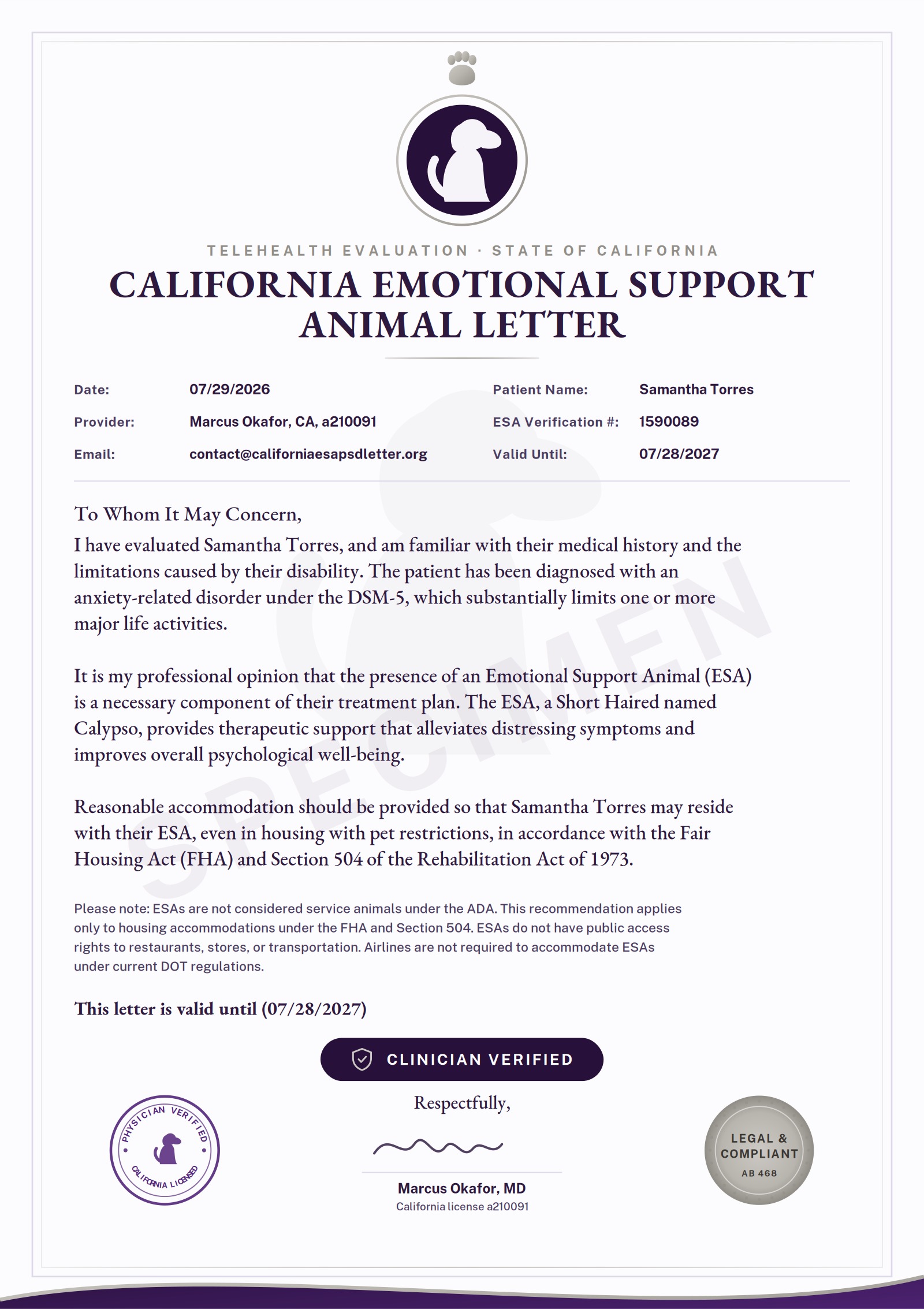
The document
What Your ESA Letter Looks Like
Every letter carries the five elements Health & Safety Code §122318 requires, on the page where a housing provider can see them.
- License in full. Type, number, issuing jurisdiction and effective date.
- Licensed where you are. Confirmation the clinician may practice in your jurisdiction.
- Thirty-day relationship. Evidence the statutory care period was met.
- Completed clinical evaluation. An assessment of your need for the animal.
- The §365.7 notice. The disclosure California requires you to receive.
- Need without diagnosis. Your accommodation need, with your diagnosis kept private.
Specimen only. Patient name, provider, license number and verification number shown here are illustrative and are populated from your own clinician’s record on a real letter.
Keep reading
Explore the Rest of the Site
Everything here is written for California specifically — the statutes, the prices and the process are all state law rather than general advice.
Home
How the process works, what we help with, and fifteen of the questions we are asked most.
Read this pageAbout us
Our standards, how the clinician network is built county by county, and the shortcuts we refuse.
Read this pageESA letter for housing
How an ESA letter works with California landlords, HOAs and student housing, and what to do if a request is refused.
Read this pageESA letter renewal
Whether California ESA letters expire, when renewal is worth doing, and how it works for existing clients.
Read this pageCost
Four prices in full, what each one includes, and what happens to your money if you are not approved.
Read this pageBook an appointment
Pick a video slot with a clinician licensed in your own California county.
Read this pageNext step
Start Your California ESA Evaluation
The intake call is free. You will leave it knowing whether a letter is the right tool, what it costs, and the date it can be issued.
Free 15-minute intake · no charge if you are not approved